 Time Magazine recently picked their 100 Greatest English-language novels from 1923 to the present, and Alan Moore’s Watchmen made the list, the only comic to do so.
I won’t argue it’s inclusion, as it’s easily my favorite comic of all time. I’ve read it more times than I can count and every time I pick it up again I notice something new. It’s filled with thickly layered dialogue, recurring thematic elements, and metaphor both obvious and subtle. Practically every line of text and every panel of art means something, even when it’s not readily identifiable at first. On top of that, it’s an engaging story with masterfully intertwining subplots involving the most human and believable (fictional) character to ever appear in a comic. And, most likely, you’ll never see the ending coming (M. Night Shyamalan wishes he could be this unpredictable.)
Time themselves summed it up well with their review:
Watchmen is a graphic novel’a book-length comic book with ambitions above its station’starring a ragbag of bizarre, damaged, retired superheroes: the paunchy, melancholic Nite Owl; the raving doomsayer Rorschach; the blue, glowing, near-omnipotent, no-longer-human Doctor Manhattan. Though their heyday is past, these former crime-fighters are drawn back into action by the murder of a former teammate, The Comedian, which turns out to be the leading edge of a much wider, more disturbing conspiracy. Told with ruthless psychological realism, in fugal, overlapping plotlines and gorgeous, cinematic panels rich with repeating motifs, Watchmen is a heart-pounding, heartbreaking read and a watershed in the evolution of a young medium.
This book is highly recommended to anyone, not just comics fans. Moore makes reference to, and pulls on influence from, sources as far-reaching as Burroughs, Taxi Driver, Nietzsche, Bob Dylan and Iggy Pop. So there’s probably a little something for everyone in there. It may involve superheroes, but it goes much deeper and wider than that.
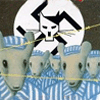 While I don’t disagree with the inclusion of Watchmen, I do have to take exception to their exclusion of Art Spiegelman’s Maus: A Survivor’s Tale. The only comic to ever win a Pulitzer, it’s of much broader interest than the superhero-themed Watchmen. At it’s highest level, it’s the story of Spiegelman’s father’s life as a Jew during World War II, being one of the few Jew’s to come out of Auschwitz alive. But there’s a deeper examination of his own relationship with his father, and with his family as a whole that makes for one of the most engaging and heartbreaking tales of I’ve ever read, comic or otherwise. Perhaps it was excluded because it’s non-fiction?
Maus is also highly recommended reading. If you haven’t read it yet, you should.